Showing posts with label ByteBuffer. Show all posts

Tuesday, 12 February 2013

Alignment, Concurrency and Torture (x86)

Summary: Exploring the effects of unaligned/aligned concurrent access in Java for off/on heap memory, how to test for correctness, torture and cushions. 

Concurrent access to memory is a pain at the best of times. The JMM offers Java programmers a way to reason about concurrency in a platform independent manner, and while not without fault it's certainly better then having no memory model at all. Other languages are catching up of course, but the focus of this article is not comparative concurrency, so look it up yourselves ;).
When we go off heap via Unsafe or Direct Byte Buffers, or when we utilize Unsafe to gain direct access to on heap memory we are on our own. Direct memory access strips away the JVM guarantees and leaves you exposed to the underlying OS/architecture memory access rules and the interpretation of the JVM runtime.
Should you be worried?
Silly question.
If you are not the worried type, follow this link with my blessings.
Worried? Here's 2 guarantees now gone to worry about:
  • Atomicity - memory access on the JVM is guaranteed to be atomic, even when the underlying system does not support it. No such similar guarantees are available for ByteBuffers. In fact ByteBuffers are explicitly not thread safe, so atomicity is not guaranteed at all. Unsafe has no guarantees for anything, so caution is advised.
  • Word tearing - this means concurrent updates to adjacent bytes in memory do not result in corruption of state. Some processors perform memory writes in units of a word, which can be 2 or 4 bytes. This can result in the unmolested parts of the word overwriting bytes written to by other threads. While the JLS is binding for 'plain' memory access (via assignment) the guarantee does not necessarily extend to off heap memory.
The problem with verifying these behaviours is that concurrency guarantees and issues are by definition timing dependent. This means that while most of the time there is no issue, that is not to say that throwing a few extra processors in, or changing memory layout, or maybe just waiting a bit longer will not trigger the issue...
So how do you prove your code is thread safe once you stepped off heap and into the wild? I recently answered a question on stack overflow regarding testing for correctness under multi-threaded access of a data structure. My answer was accepted, so obviously it's correct, I cut out the niceties to keep this short:
 1.  Formally prove the correctness of your program in the terms of the JMM. 

 2.  Construct test cases which demonstrate intended above behaviour by using count down latches or other means of suspending threads of execution at specific points in your program to force contention.

 3.  Statistically demonstrate correctness by exercising the code over a sufficient period of time from multiple threads.
This is all fine for when you write 'safe' Java, but option 1, and therefore 2 go out the window when you are straying off spec. This is an important observation to make: if the rules are not well defined then testing the edge cases for those rules is not that meaningful.
Which leaves us with number 3.

Science is torture

It is a fact well known to those who know it well that a scientific experiment can only prove your theory is either definitely wrong or so far right. This (limited) power of induction from past experiences is what empiricism is all about. To prove JVM implementations implement the JMM correctly Mr. Shipilev (Benchmarking Tzar) has put together the Java Concurrency Torture Suite into which he drags JVMs and tries to break them on any number of architectures (not to worry, he tries it on cute bunnies first). It's a great project for anyone trying to reason about the JMM as it gives you examples in code of edge cases and the corresponding range of expected behaviours on all architectures. It also means that if you got questionable behaviours you want to explore on a particular architecture Aleksey just saved you allot of work.
The JCTS project is a very professional piece of work, so I'll try not to mince words over what you can read in the readme. The general approach is that if you leave it (the concurrent behaviour) long enough the edge cases will come crawling out of the woodwork. Here's one bug found using it, the discussion in the ticket is quite interesting.
The tests run also report how many times each state was detected, which has the added benefit of educating us on the distribution of occurrences for the different cases. The next version may support ASCII bar charts too. Instead of yapping on about it, lets see how atomicity is tackled and all will become clear.


Biggles! Fetch...THE CUSHIONS!

The JCTS already has atomicity tests, I just had to my own to target unaligned access. I added 2 tests, one for unaligned access within the line and one for crossing the cache line, for brevity this is just the long test:
The method for allocating aligned direct memory byte buffers is described in this post. The cross cache line case is very similar with the position being set intentionally to cause cache straddled access.
I expected the straddled line access to be non-atomic and for once I was right(read on, it doesn't last)!!!
Note the fine printed output, a joy! The test run several times and we can see how in the majority of cases things are fine, the observed result is either 0 or -1. But there are other values which should not be there (when our mother is not), those observed values are the result of the lack of atomicity. Reading the value in some undefined trashed state gives us... mmm... trash. As I suspected! Patting myself on the shoulder I moved on to the unaligned non-straddling tests.
The results suggested that unaligned access inside the cache line is atomic on my machine. I admit it was not what I thought. This is a bit surprising. Good old Intel, they can really make this work!


Our chief weapon is surprise

Going through these experiments and results reminded me of a comment made by Gil Tene (Azul CTO) on Martin Thompson's blog:
Cache alignment is only a performance issue. Never a correctness issue. Cache lines do not add or remove atomicity. Specifically, non atomic updates within a single cache line can still be seen non-atomically by other threads.The Java spec only guarantees atomic treatment (as in the bits in the field are read and written all-or-nothing) for boolean, byte, char, short, int, and float field types. The larger types (long and double) *may* be read and written using two separate operations (although most JVMs will still perform these as atomic, all-or-nothing operations).
BTW, all x86 variants DO support both unaligned data types in memory, as well as LOCK operations on such types. This means that on an x86, a LOCK operations that spans boundary between two cache lines will still be atomic (this little bit of historical compatibility probably has modern x86 implementors cursing each time).
I read the above to suggest Gil was thinking atomicity is a given across the cache line, so I sent him an e-mail to discuss my findings. Now Gil has been under the JVM hood more than most people, and this turned out to be quite enlightening:
I'm not saying that cross cache line boundaries cannot induce non-atomicity to occur more often. I *am* saying that whenever you see non-atomicity on accesses that cross cache line boundaries, that same non-atomicity potential was there [for the same code] even within a single cache line, and is usually there regardless of whether or not the in-same-cache-line access is aligned to the type size boundary. 
He went on to point out that the whole experimentation as means to proving correctness is not possible (I told you it's well known) and that where the spec. doesn't promise you anything, expect nothing:
... there is no way to verify atomicity by experimentation. You can only disprove it, but cannot prove it.
The only way you can control atomicity on a known x86 arch. for off heap access would be to control ALL x86 instructions used to access your data, where knowing exactly which instructions are used and what the layout restrictions you impose would allow you to prove atomicity through known architectural qualities.


I didn't expect a kind of Spanish Inquisition

Mmmm... but how would I know? Given there are no guarantees on the one hand and the limitations of experimentation on the other, we are back to square one... And while musing on Gil's wise words I ran the unaligned access test again, and what do you know:

Bugger. Bugger. Bugger. It seems like a special value sneaks in every once in a while. This happens quite infrequently and as things worked out it failed to happen until my little exchange with Gil was over, leading me to believe Gil possesses that power of the experienced to have reality demonstrate for them on cue. On the other hand, now I know it doesn't work. Certainty at last.
What about aligned memory access? I gave it a good run and saw no ill effects, but given Gil's warnings this may not be enough. The JCTS already had a test for aligned access and there are no particular expectations there. This is important: it is OK for a JVM implementation to give you no atomicity on putLong/Int/... (via Unsafe or DirectByteBuffer). Aligned access on x86 is atomic, but as Gil points out we don't have full control on every level so that may not be a strong enough guarantee...

Conclusion? 

The take away from the above is that offheap storage should be treated as if atomicity is not guaranteed, unless read/write alignment is properly handled. Is that the end of the world? certainly not, but it does mean precautions must be taken if data is to be written and read concurrently. Note that mutating shared data is always a risk, but you may go further without noticing issues with a POJO approach. Also note that some of the tools used for proper object publication are not available, in particular final fields.


Many thanks to Aleksey Shipilev and Gil Tene for their feedback and guidance along the way. I leave word tearing as an exercise to the interested reader.

Update 14/02/2013:
Martin Thompson got back to me asking if the same atomicity issue is still there for putOrdered*/put*Volatile when the cache line is crossed. I expected it would be (so did he), wrote some more tests and it turned out we were both correct. It makes no difference if you use put*/putOrdered*/put*Volatile/compareAndSwap* [correction: CAS is atomic see update 23/09/2013 below], if you cross the cache line there is no atomicity. Similarly I would expect unaligned access within the cache line to lack atomicity, but have not had time to add the tests. Code is on GitHub for your pleasure.
Thanks Martin.

Update 24/07/2013:
JCT has gone into the OpenJDK toolbox and is now public again as JCStress (I suggested JangBang, but Shipilev wouldn't listen :-(). I 'forked' it and added my tests to the new project, it's all available here. The tests are under the org.openjdk.jcstress.tests.unsafe.unaligned package.

Update 23/09/2013:
I've written a further post on JCStress here. And a further clarification on the atomicity of unaligned writes using different methods here. The bottom line being that the only method to perform guaranteed atomic unaligned writes is by using CAS. Volatile reads are not atomic however, so this method is of limited use.

Monday, 3 December 2012

Encode UTF-8 String to a ByteBuffer - faster

Summary: By utilizing Unsafe to gain access to String/CharBuffer/ByteBuffer internals and writing a specialized UTF-8 encoder we can get a significant(> 30%) performance gain over traditional methods and maintain that advantage for both heap and direct buffers across different JDK versions.

"Not all who wonder are lost"

Not so recently I've been looking at this code that de-serializes messages through a profiler and a hotspot came up around the decoding/encoding of UTF8 strings. Certainly, I thought to myself, this is all sorted by some clever people somewhere, had a look around and found lots of answers but not much to keep me happy. What's the big deal you wonder:
  1. UTF8 is a clever little encoding, read up on what it is on Wikipedia. Not as simple as those lovely ASCII strings and thus far more expensive to encode/decode. The problem is that Strings are backed by char arrays, which in turn can only be converted back and forth to bytes using encodings. A UTF8 char can be encoded to 1-4 bytes. The Strings also do not have a length in bytes, and are often serialized without that handy piece of information being available, so it's a case of finding how many bytes you need as you go along (see the end result implementation for a step by step).
  2. Java Strings are immutable and defensive, if you give them chars they copy it, if you ask for the chars contained they get copied too.
  3. There are many ways to skin the encoding/decoding cat in Java that are considered standard. In particular there are variations around the use of Strings, Charsets, arrays and Char/Byte buffers (more on that to come).
  4. Most of the claims/samples I could find were not backed by a set of repeatable experiments, so I struggled to see how the authors arrived at the conclusions they did.

"Looking? Found someone you have!"

After much looking around I've stumbled upon this wonderful dude at MIT Evan Jones and his excellent set of experiments on this topic Java String Encoding and his further post on the implementation behind the scenes. Code is now on GitHub(you'll find it on his blog in the form of a zip, but I wanted to fork/branch from it): https://github.com/nitsanw/javanetperf and a branch with my code changes is under https://github.com/nitsanw/javanetperf/tree/psylobsaw

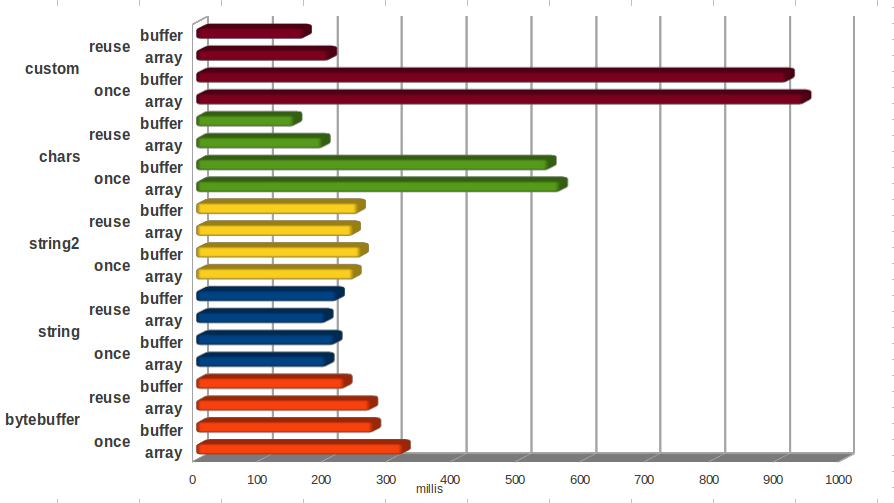
Having downloaded this exemplary bit of exploratory code I had a read and ran it (requires python). When I run the benchmarks included in the zip file on my laptop I get the following results(unit of measurement has been changed to millis, upped the test iterations to 1000 etc. The implementation is the same, I was mainly trying to get stable results):

* The above was run using JDK 1.6.37 on Ubuntu 12.04(64bit) on with an i5-2540M CPU @ 2.60GHz × 4.
I find the names a bit confusing, but Mr. Jones must have had his reasons. In any case here's what they mean:
  • bytebuffer - uses a CharBuffer.wrap(String input) as the input source to an encoder.
  • string - uses String.getBytes("UTF-8")
  • chars - copies the string chars out by using String.getChars, the chars are the backing array for a CharBuffer then used as the input source to an encoder.
  • custom - steals the char array out of String by using reflection and then wrapping the array with a CharBuffer.
  • once/reuse - refers to the encoder object and it's bits, weather a new once was created per String or the same reused.
  • array/buffer - refers to the destination of the encoding a byte array or a ByteBuffer.
The story the above results tell is quite interesting, so before I dive into my specialized case, here's how I read them:
  • There are indeed many flavours for this trick, and they vary significantly in performance.
  • The straight forward, simplest way i.e. using String.getBytes() is actually not bad when compared to some of the other variations. This is quite comforting on the one hand, on the other hand it highlights the importance of measuring performance 'improvements'. 
  • The best implementation requires caching and reusing all the working elements for the task, something which happens under the hood in String for you. String also caches them in thread local variables, so in fact gives you thread safety on top of what other encoding implementations offer.
  • Stealing the char array using reflection is more expensive then copying them out. Teaching us that crime does not pay in that particular case.
One oddity I stumbled on while researching the topic was the fact that using String.getBytes(Charset) is actually slower then using the Charset name. I added that case as string2 in the chart above. This is due to the getBytes(String) implementation re-using the same encoder(as long as you keep asking for the same charset) while the one using the Charset object is creating a new encoder every time. Rather counter intuitive as you'd assume the Charset object would spare String.getBytes the need to look it up by the charset name. I read that as the JDK developers optimizing for the most common case to benefit the most users, leaving the less used path worse off. But the lesson here is again to measure, not assume.

"Focus!"

The use case I was optimizing for was fairly limited, I needed to write a String into a ByteBuffer. I knew a better way to steal the char array, as discussed in a previous post, using Unsafe(called that one unsafe). Also, if I was willing to tempt fate by re-writing final fields I could avoid wrapping the char array with a new CharBuffer(called that one unsafe2). I also realized that calling encoder.flush() was redundant for UTF-8 so trimmed that away(for both unsafe implementations, also did the same for chars and renamed chars2). Re-ran and got the following results, the chart focuses on the use case and adds relevant experiments:


We got a nice 10% improvement there for stealing the char[] and another 5% for re-writing a final field. Not to be sneezed at, but not that ground breaking either. It's worth noting that this is 10-15% saved purely by skipping a memory copy and the CharBuffer wrap, which tells us something about the cost of memory allocations when compared to raw computation cycles.
To further improve on the above I had to dig deeper into the encoder (which is where unsafe3 at above comes into play)  implementation which uncovered good news and bad news.

"The road divides"

The bad news were an unpleasant little kink in the works. As it turns out string encoding can go down 2 different paths, one implementation is array based for heap ByteBuffers(on heap, backed by arrays), the other works through the ByteBuffer methods(so each get/set does explicit boundary checks) and will be the chosen path if one of the buffers is direct (off heap buffers). In my case the CharBuffer is guaranteed to be heap, but it would be quite desirable for the ByteBuffer to be direct. The difference in performance when using a direct ByteBuffer is quite remarkable, and in fact the results suggest you are better off using string and copying the bytes into the direct buffer. But wait, there's more.

"And then there were three"

The good news were that the topic of String encoding has not been neglected and that it is in fact improving from JDK version to JDK version. I re-run the test for JDK5, 6 and 7 with heap and direct buffers. I won't bore you with the losers of this race, so going forward we will look only at string, chars2, and the mystery unsafe3. The results for heap buffers:
Heap buffer encoding results
The results for direct buffers(note the millis axis scale difference):
Direct buffer encoding results
What can we learn from the above?
  • JDK string encoding performance has improved dramatically for the getBytes() users. So much in fact that it renders previous best practice less relevant. The main benefit of going down the Charset encode route is the memory churn reduction.
  • The improvement for the unsafe implementation suggests there were quite a few underlying improvements in the JIT compiler for in-lining intrinsics.
  • Speed has increased across the board for all implementations, joy for all.
  • If you are providing a framework or a library you expect people to use with different JDKs and you need to provide comparable performance you need to be aware of underlying implementation changes and their implications. It might make sense to back port bit of the new JDK and add them to your jar as a means of bringing the same goods to users of old JDKs. This sort of policy is fairly common with regards to the concurrent collections and utilities.
 And now to unsafe3...

"Use the Source Luke"

At some point I accepted that to go faster I will have to roll up my sleeves and write an encoder myself(have a look at the code here). I took inspiration from a Mark Twain quote: "The kernel, the soul — let us go further and say the substance, the bulk, the actual and valuable material of all human utterances — is plagiarism.". No shame in stealing from your betters, so I looked at how I could specialize the JDK code to my own use case:
  •  I was looking at encoding short strings, and knew the buffers had to be larger then the strings, or else bad things happen. As such I could live with changing the interface of the encoding such that when it fails to fit the string in the buffer it returns overflow and you are at the same position you started. This means encoding is a one shot operation, no more encoding loop picking the task up where they left it.
  • I used Unsafe to pick the address out of the byte buffer object and then use it to directly put bytes into memory. In this case I had to keep the boundary checks in, but it still out performed the heap one in JDK7, so maybe the boundary checks are not such a hindrance. I ran out of time with this, so feel free to experiment and let me know.
  • I tweaked the use of types and the constants and so on until it went this fast. It's fiddly work and you must do it with an experiment to back up your theory. At least from my experience a gut feeling is really not sufficient when tuning your code for performance. I would encourage anyone with interest to have a go at changing it back and forth to the JDKs implementation and figuring out the cost benefit of each difference. If you can further tune it please let me know.
  • Although not explicitly measured throughout this experiment there is a benefit in using the unsafe3 method(or something similar) in reducing the memory churn involved in the implementation. The encoder is very light weight and ignoring it's own memory cost involves no further memory allocation or copying in the encoding process. This is certainly not the case for either the chars2 solution or the string one and the overhead is proportional to the encoded string length.
  • This same approach can be used to create an encoder that would conform to the JDK interface. I'm not sure what the end result would perform like, but if you need to conform to the JDK interface there's still a win to be had here.
  • The direct buffer results suggest it might be possible to further improve the heap buffer result by using unsafe to put the byte in rather than array access. If that is the case then it's an interesting result of and by itself. Will be returning to that one in future.

And there you have it, a way to encode strings into byte buffers that is at least 30% faster then the JDK provided ones(for now) which gives you consistent performance across JDK versions and for heap and direct buffers :)

References: